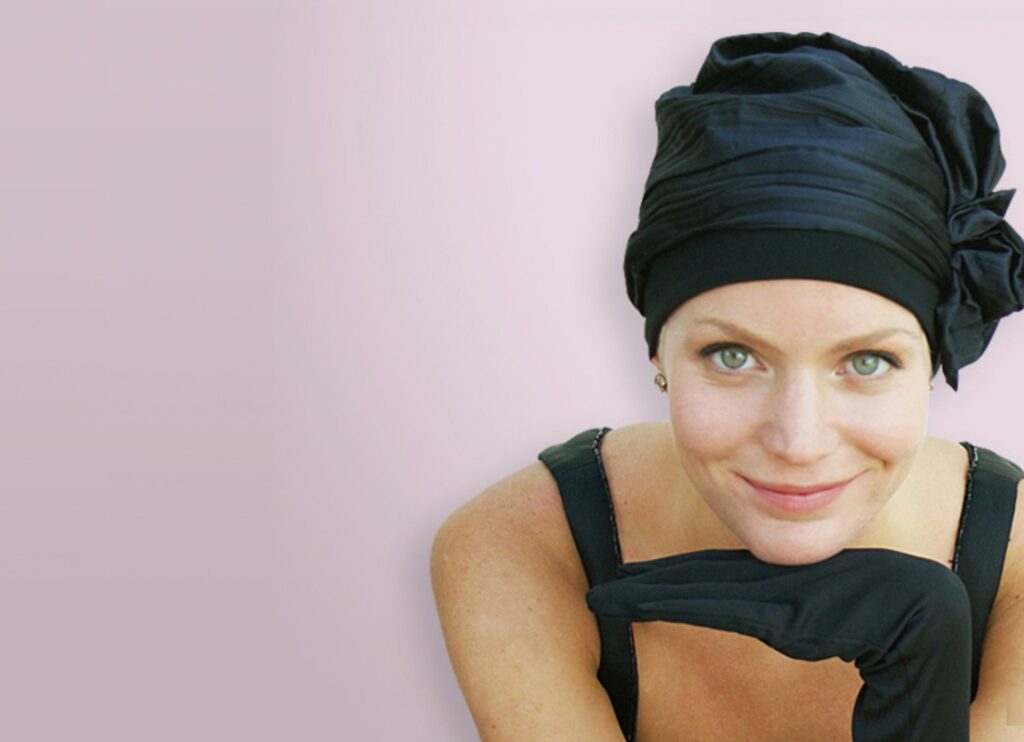
If you’re losing your hair during chemo, a scarf can be a cooler (wig alternative) and soft everyday wear. Read on for tips on how to tie a chemo head scarf using a square (90 x 90 cms), or rectangular scarf (180 x 70 cms). Quick easy styles that can be folded and wrapped in minutes to create fashionable head wrap styles. Note the sizes – you need enough fabric to tie to ensure your head wrap stays secure all day.
Step-by-step: the basic square scarf wrap
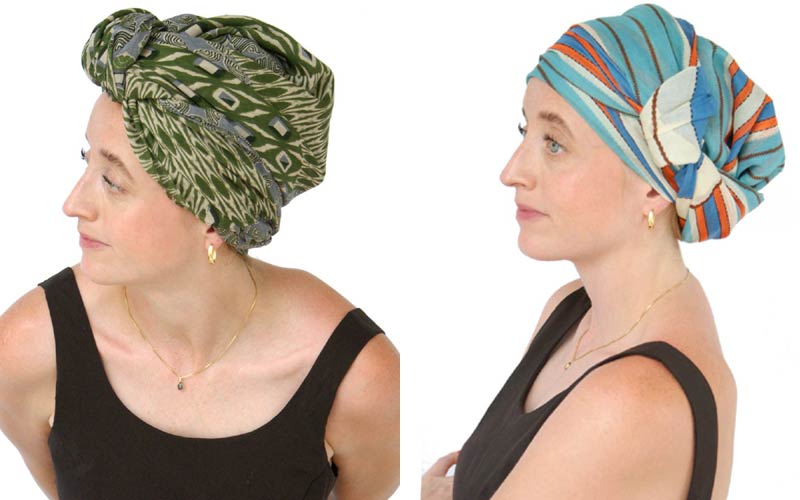
Looking at a square scarf wrap first, (picture on the left). Again worth noting not all front tying square scarf wraps have to be held in place with a large ‘knot’ at the front. Here’s how –
- Fold your square scarf in half diagonally to form a triangle.
- Place the folded edge at the nape of your neck, with the point hanging over your head and down your forehead. If the scarf is larger simply make a fold under at the nape of the neck to shorten the triangular point.
- Take the two side ends and pull them forward in front of your head. Over the point make the first knot tie – this will hold the scarf in place whilst you adjust.
- Gather the front triangular point into the centre and loop back over and tuck under the first knot tie you’ve made.
- Then pick up the scarf ends and finish your knot on the nape of the neck. You can tuck this away completely under the scarf.
- If the scarf is too smooth over the back of your head, gently pull it backward on the crown to loosen it off and release some of the fabric from the front roll. You can easily tuck it back in if you release too much.
This basic wrap provides complete coverage for fine regrowth, none at all, or indeed if you have some hair left in areas – show off a fringe peeping out / straggler hair threads around the ears. Scarves to hide thinning hair or patchy hair loss can be really useful in managing your day to day hair loss – see our scarf headband guide here.
Step-by-step: the basic rectangular scarf wrap
Now let’s take a look at the picture on the right. Both are great head wrap shapes for different reasons. If you face shape is complemented by more height consider the first method with a square scarf. If you’ve got a long narrow face, adding a little more width around the head can provide a flattering turban style.
- Take your long scarf and fold it in half along the length, or at least so that you have enough width to cover the head front to back.
- Then place it over your head with a short end on your left (approx. 30 cms from your chin), long end (approx. 100 cms from your chin).
- Cross over ends at the back of your head on the neck, and continue to wrap the long end round your head till it meets the short end, on the righthand side of your head.
- Tie off – tying long end over short end and pull to tighten. I’ve not used a knot here – only one tie. (A granny knot looks too bulky.)
- Then tuck the long end in, back over your forehead. This creates volume and helps hold the wrap in place.
- You are then left with the dangling short end which can be worn as is, or looped back over the tie area and tucked behind to create added side volume.
- If you wish to have the loop on the other side simply start off with your short end on your right, then when you crossover the tie ends up on your left side.
Choosing the right scarf for hair loss
Not every scarf is comfortable against a scalp that’s sensitive from treatment. Look for soft, breathable natural fabrics — cotton, bamboo, or lightweight viscose — rather than anything synthetic. Our headscarf ranges have been selected specifically with hair loss in mind. So all will have enough length to wrap and tie securely without slipping. There are no heavy synthetics for this reason too – the slip factor – you need to feel secure and cool in what you wear.
Head wraps can be considered to be hot wear in the summer temperatures. There are plenty of cotton voiles, silk alternatives that help wick perspiration away and are cooler to wear. There is always a slight trade off, if you’re looking to replace hair volume with a scarf (a great idea!), it will involve wrapping fabric to create shape.
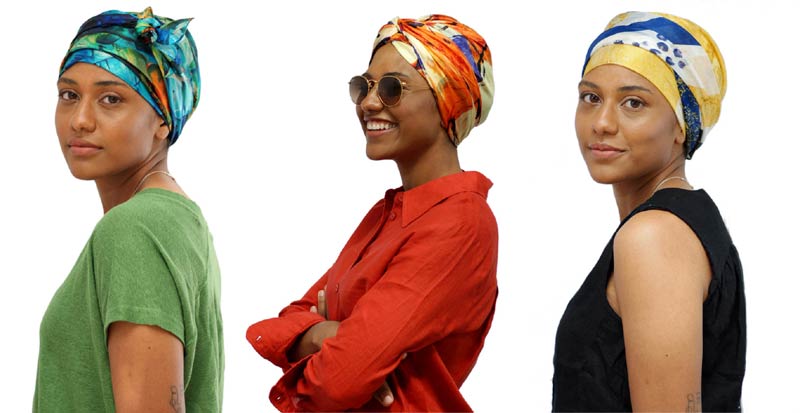
A selection of our large long silk scarves – starting at £49
A secure style for all-day wear
If you’re wearing your scarf for extended periods i.e to cover any form of hair loss, think bigger scarf size formats. Don’t be put off by the amount of fabric it simply means you can tie it securely and it will stay put all day.
Frequently asked questions
What’s the best way to tie a scarf for hair loss?
Start with a simple front-tie head wrap and adjust the style to suit your face shape. This is entirely down to personal choice — I’d advise giving yourself time in front of a bathroom mirror to see how a scarf wraps up. Once you find your style, stick with it, and change it up with different fabrics and prints.
How do you keep a head scarf from slipping on a bald head?
Avoid slippery synthetic satins and skip the knot if you don’t have much of a “bump” at the back of your head — wrap and tuck the ends in instead. The weight of a knot can gradually pull a scarf down and off, and the same is true for flatter head shapes even without slippery fabric; without that weight, the scarf won’t rotate or pull off backwards. If you’re concerned about it staying secure all day, hijab pins hidden in the folds are a good backup — they can be magnets, flat safety pins, and ordinary straight-pin formats.
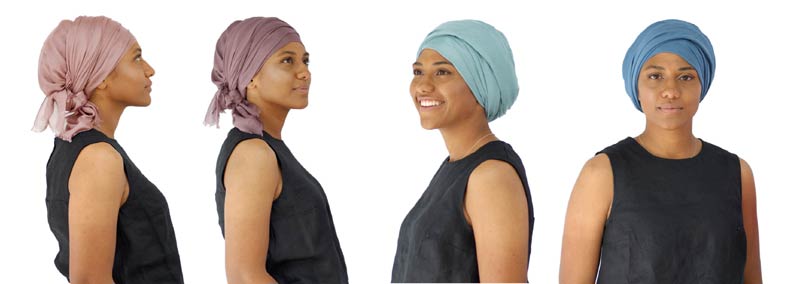
Our soft modal / viscose scarf range – £28 – for all colour shades click on link
What fabric is best for a chemo head scarf?
Natural fibres like cotton or bamboo are softer on a scalp that’s sore or sensitive from treatment, though they can wrap up quite warm. Some of the lightest gauge scarves I’ve found in 17+ years of research are viscose voiles — they need folding to create a double layer (to avoid show-through), but stay cool and lightweight. It really depends on the cause of irritation: early-treatment sensitivity tends to settle with time, so it’s best to avoid tying too tightly or wearing beanies and elasticated jerseys that hug the head. If irritation is from a fungal infection or Cicatricial alopecia, always follow your GP or dermatologist’s advice.
Shop our full range of headscarves for hair loss in modal, silk, cotton and bamboo HERE.